

|
iX Biopharma's latest corporate presentation, prepared for the 23 Sept CITIC Securities International Investor Forum, contains several revealing details — especially when viewed against the extraordinary rise in iX's share price over the past year. Available on the SGX website, the deck shows the shares rising from roughly 2 cents in Sept 2025 to above 60 cents in Sept 2026 — around a 30-fold increase. Market capitalisation had reached about S$629 million as at 17 Sept. 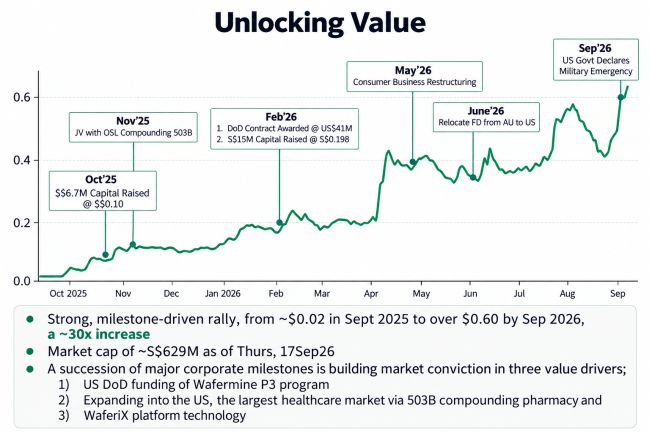 Source: iX Biopharma Source: iX Biopharma
|
| Paying S$600M for future value |
A year ago, iX was valued like a distressed small biotech, with an interesting technology to deliver drugs through wafers placed under the tongue.
Today, investors are paying more than S$600 million for future success — principally Wafermine and, to a lesser extent, the wider WaferiX platform and US compounding opportunity.
So judging iX simply by its current revenue or near-term PE ratio misses the point.
The stock is increasingly being valued on the probability that Wafermine becomes a valuable late-stage pharmaceutical asset — plus some value for the US compounding opportunity. Eddy Lee, Founder, Chairman & CEO of IX Biopharma
| Why the huge value potential |
iX points investors towards actual transactions occurring in non-opioid pain.
The presentation highlights Eli Lilly's acquisition of SiteOne Therapeutics for up to US$1 billion, despite its lead non-opioid pain drug being only Phase 2-ready.
Importantly, the US$1 billion is not all upfront cash: it includes an undisclosed initial payment plus future regulatory and commercial milestone payments.
iX also cites AbbVie's deal worth up to US$745 million for two early-stage pain assets. US$30 million was paid upfront, with most of the potential value dependent on the drugs successfully reaching future milestones.
And iX notes analyst estimates of US$2–4 billion peak sales for Vertex's newly approved non-opioid pain drug Journavx.
Journavx (suzetrigine) is a much more relevant comparison because it treats the same broad indication as iX's Wafermine: moderate-to-severe acute pain.
FDA approved Journavx in January 2025, making it the first approved drug in a new class of non-opioid pain medicine.
Wafermine offers a different product profile. Journavx is an oral tablet. Wafermine is a sublingual ketamine wafer designed to enter the bloodstream rapidly.
iX cites Wafermine onset of 10–20 minutes versus Journavx's 1–2 hours.
If its Phase 3 is successful, Wafermine could be particularly valuable in:
- emergency medicine;
- postoperative acute pain;
- battlefield medicine;
- situations where rapid relief is important but injection is undesirable.
iX is showing that Big Pharma really is paying substantial sums for promising non-opioid pain assets.
This implies that a successful Phase 3 Wafermine could potentially attract a large pharmaceutical partner or buyer.
iX says the US government will provide about US$41 million for the Phase 3 and Emergency Use Authorization (EUA) programme, removing one of the biggest traditional biotech risks: who pays for Phase 3? The regulatory sequence also remains unchanged. The military emergency pathway has been opened, but Wafermine's EUA submission itself is still pending. Meanwhile, on the conventional commercial pathway, the next milestones remain |
 For earlier story, see: For earlier story, see:
iX BIOPHARMA: Why a Rare US Emergency Declaration Matters for Its Star Product |


