

|
Food Empire is already a much bigger business than it was a few years ago. Revenue reached US$476 million in 2024, but UBS thinks the story is only halfway written. |
UBS believes Food Empire has the pieces in place, and assigns a 1-year forward price target of S$3.00.
That, it says, values Food Empire at 18.1x 1-year forward P/E, in line with global coffee manufacturers (excluding Indian peers).
The broker forecasts revenue growth of around 10% annually from FY2025 to FY2031, taking sales from US$577 million in 2025 to US$661 million in 2026, before crossing US$1 billion in 2031.
|
FY |
Revenue (US$m) |
Net earnings (US$m) |
P/E (x) |
|
2024A |
476 |
50 |
8.8 |
|
2025A |
577 |
69 |
12.3 |
|
2026E |
661 |
77 |
17.2 |
|
2027E |
736 |
81 |
16.4 |
|
2028E |
811 |
88 |
15.1 |
|
2029E |
884 |
102 |
13.1 |
|
2030E |
953 |
109 |
12.2 |
Source: UBS estimates.
One interesting feature is that UBS expects revenue to rise about 44% from 2026 to 2030, while earnings rise about 42%, so the P/E compresses from 17.2x to 12.2x if the share price were unchanged.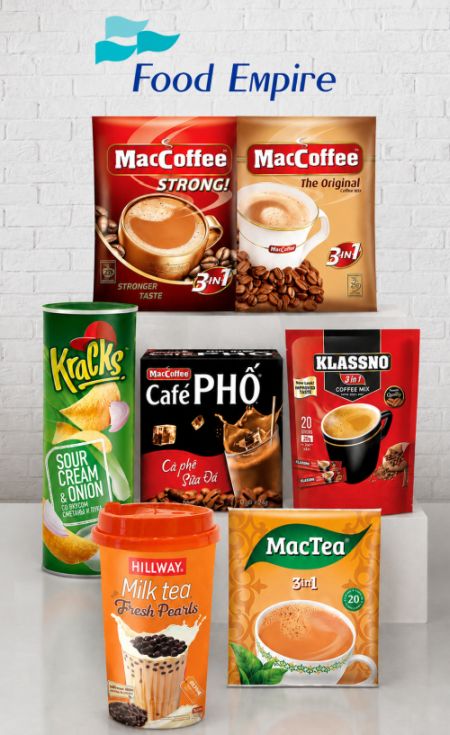
Food Empire already has Russia and the CIS as its foundation.
UBS estimates Food Empire has around 50% of Russia's overall instant-coffee market, while MacCoffee holds more than 60% of the 3-in-1 segment.
How it got there: UBS points to a distribution network built over three decades, reaching tens of thousands of shops, particularly in smaller cities where competitors have found Food Empire difficult to dislodge.
Then add US$147 million of new capacity. Food Empire has committed around US$147 million to major manufacturing projects in Kazakhstan, India and Vietnam.
India's spray-dried coffee capacity is being increased 60%, from 6,000 tonnes to 9,600 tonnes annually, for US$37 million.
Vietnam is getting a new 5,400-tonne freeze-dried coffee plant, which UBS expects to rank among Southeast Asia's largest.
And Kazakhstan gives Food Empire something simple but valuable: the ability to manufacture closer to customers instead of shipping coffee mixes halfway across the world.
Food Empire's ingredients business—spray-dried coffee, freeze-dried coffee and non-dairy creamer—grew at a 36% CAGR from 2020 to 2025 and now contributes more than 17% of group revenue.
New capacity can initially be sold to third-party customers.
As MacCoffee, CaféPHO and other Food Empire brands grow, production can be redirected internally toward higher-margin branded products.
| Keep Vietnam On Radar |
Vietnam offers another opportunity uplift. CaféPHO has risen from No. 4 to No. 2 in Vietnam's instant coffee-mix market over the past two years.
| Still at a discount |
| "Investors increasingly recognise FEH's stronger earnings profile, improving liquidity (3-month ADTV: S$159k in Q122 vs S$4.5m in Q226) and more shareholder-friendly capital allocation (payout ratio: 15% in FY18 vs 73% in FY25)... Despite the re-rating, FEH trades at ~15x 1-year forward P/E, a 22% discount to global instant coffee peers despite similar earnings growth." -- UBS |
Food Empire has spent heavily to get there.
UBS estimates Vietnam devotes around 10% of sales to advertising and promotion.
Management deliberately eased promotional spending in 2026 to see how much growth and profitability previous investments could generate on their own.
That fits CEO Sudeep Nair's broader philosophy: spend where opportunities are attractive, pull back where necessary, and judge success by what the whole portfolio of markets produces.
The US$1 billion number isn't the most important number.
UBS expects Food Empire to maintain ROIC above 20% and sees dividends growing around 16% annually. And that is the point: Anyone can double revenue if they spend enough money doing it. The trick is doubling the business while earning attractive returns on the additional capital.
UBS's US$1 billion revenue forecast may make a good headline number and the stock has rallied more than 200% over the past two years. |
 → See also:Triple Catalysts: How Record Revenue, Cheaper Coffee Beans, and a Bonus Issue Make FOOD EMPIRE a Top Pick


