

|
Wee Hur Holdings’ 1H2026 results show its Singapore construction and workers’ accommodation businesses gaining momentum, but the more intriguing story lies thousands of kilometres away in Queensland. |
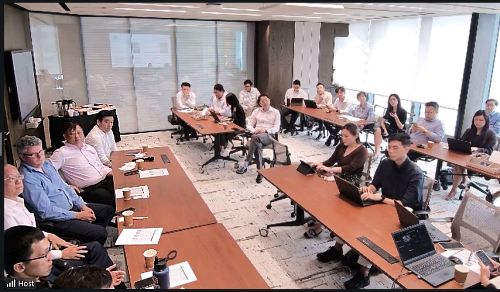
5 key topics:
1. The underlying operating businesses are growing much faster than the headline revenue suggests.
Revenue rose just 4.9% to S$163.6m, but 1H2025 contained a S$38.4m one-off performance fee from Wee Hur selling the bulk of its student accommodation portfolio (ie Fund I PBSA exit).
Excluding that fee, Wee Hur says 1H2026 revenue actually grew 39.1% y-o-y.
The two standout businesses were workers’ accommodation and construction.
PATMI increased 17.1% to S$45.3m, despite the absence of the Fund I performance fee.
But it includes substantial “other gains and losses”—such as investment/derivative/FX gains and the S$9.4m gain from the partial disposal of Lowood One land (more on this below).
| Aussie land bank |
2. There is considerable value-creation potential in Australia.
Through subsidiaries and joint ventures, the group controls five Queensland land parcels totalling about 2 million sq m.
Lowood One provides an early glimpse of what those assets could eventually be worth.
Wee Hur obtained development approval for 358 residential lots at Lowood One and subsequently sold part of its interest to Australian developer Woodline, booking a S$9.4 million profit. Civil and infrastructure works are expected to begin in 3Q2026.
According to a CGS report, the first 85 Lowood lots should take around 45 weeks to prepare, with each residential lot expected to sell for at least 2.2 times Wee Hur’s investment cost.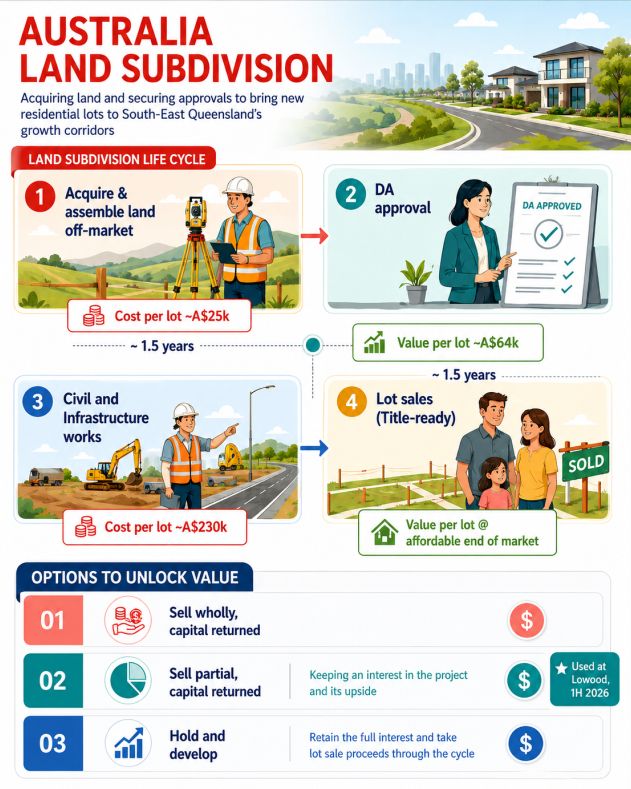
Management revealed the economics: The acquisition cost was roughly A$25,000 per lot and infrastructure spending of around A$230,000 per lot.
Importantly, Wee Hur CIO Goh Wee Ping said that because lots are progressively released and sold—and because several land projects can overlap—the land business could bring in recurring earnings:
“You would be able to expect that every year... there's some contribution from this business.”
Wee Hur does not expect much additional capital to be required as bank financing and presales of the subdivided lots can help fund infrastructure.
Lowood is a template for Wee Hur’s strategy: Obtain approvals, sell part of an asset to a developer, recover capital and retain some participation in the upside.
There's much more to come.
Cryna 1, 2 and 3 is a separate, much larger residential project with development approvals being pursued for more than 2,000 lots.
Park Central is another distinct site, where Wee Hur is seeking approval for a mixed-use development comprising about 670 student-accommodation beds, residential lots and a co-living parcel.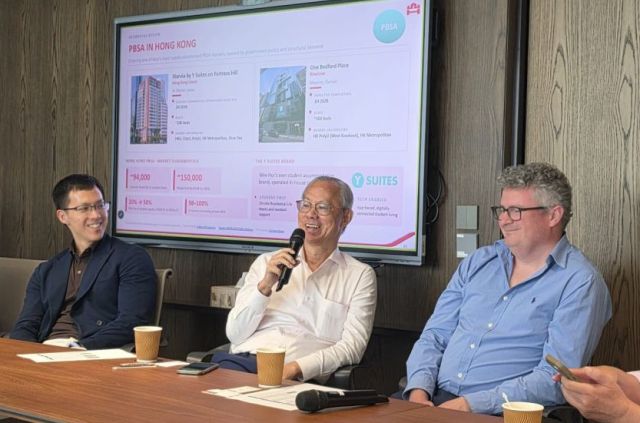 L-R: CIO Goh Wee Ping, Executive Chairman Goh Yeow Lian, CEO Wee Hur (Australia) Scott Peter William. Photo: Company
| Other key drivers |
3. Pioneer Lodge is becoming a major second cash generator.
Workers' dormitory revenue jumped 50.7% to S$63.3m.
Wee Hur's new Pioneer Lodge's 10,500 beds averaged only 65.9% occupancy in 1H, but occupancy had already reached about 85% by July.
That means 2H2026 should benefit from a much fuller six-month contribution. The other dormitory, Tuas View, remained highly occupied at around 92%.
4. Construction has moved to become an earnings driver.
Wee Hur had S$598.9m of construction orders at end-June, with projects providing earnings visibility to 2031.
Another roughly S$262m is expected to enter the order book when the Upper Thomson project is awarded to the construction arm.
On the roughly 20% construction gross margin achieved in 1H2026, management said it benefited from cost reversals on completed projects. A more normal margin, it said, would be in the low teens.
5. Wee Hur is rebuilding its student accommodation platform.
It has Y Suites on Margaret in Sydney, the 708-bed Y Suites on Frome under development in Adelaide, and two Hong Kong projects.
The company says its student-accommodation pipeline should increase from 409 beds currently to around 1,860 by 2028.
Wee Hur is trying to earn development, management and operating fees while committing less of its own capital than under a traditional property-owner model.
If you ask who the regional leader in Purpose Built Student Accommodation (PBSA) is in Asia Pacific excluding India and China, no name comes to mind, said Wee Ping.
“I think there's a gap to be filled. I think Wee Hur is in a very good position to be able to fill that.
“That's our ambition for the next five years — to scale into a regional PBSA platform.”
This is the single most important near-term uncertainty. The 15,744-bed Tuas View Dormitory lease expires on 31 Oct 2026. Management says it expects to provide an update in October. Losing Tuas View would remove a very profitable established asset. Management expects little incremental capex under a normal short-term extension. |
 → See also:WEE HUR: Joins Centurion in HK Student Market with Major 750-Bed Debut


