

ISDN Holdings' 1H2026 results may mark a turning point in the company’s earnings profile.
|
The non-cash and unrealised FX losses in 1H2025 related to the hydropower business in Indonesia.
 Teo Cher Koon, Group MD, ISDNFor analysing ISDN's underlying growth, a better comparison is: 1H25 core PATMI ~S$4.5m → 1H26 PATMI S$10.4m.
That's still well over 100% growth, which is impressive.
In 1H2026, other operating expenses fell by S$6.5m, principally because FX losses fell by S$5.2m and inventory-obsolescence provisions fell by S$1.4m.
What matters:
-
The core automation business is showing a genuine inflection. Automation is 94% of group revenue, and revenue increased 31.9% to S$238 million while gross profit increased 33.9%.
More importantly, the rebound was broad based: China automation revenue rose 26.3%, while Southeast Asia rose 53%. Singapore was +57.9%, Vietnam +46.6% and Malaysia +19%.
A good forward indicator is the order book: it has more than doubled from a year earlier, with ISDN offering capabilities extending from components into controls, software, cloud and system integration, allowing it to assemble solutions according to customer requirements.Managing director CK Teo said these are firm purchase orders with an average delivery period of around three months.
Customer rolling forecasts were also still running at roughly twice last year's levels. -
Momentum accelerated in 2Q. ISDN reported 1Q revenue of S$113.7 million and PATMI of S$3.69 million.
Subtracting those numbers from the half-year result implies S$139.9 million revenue and S$6.7 million PATMI in 2Q.
In other words, revenue increased about 23% sequentially while shareholder profit rose about 81%. -
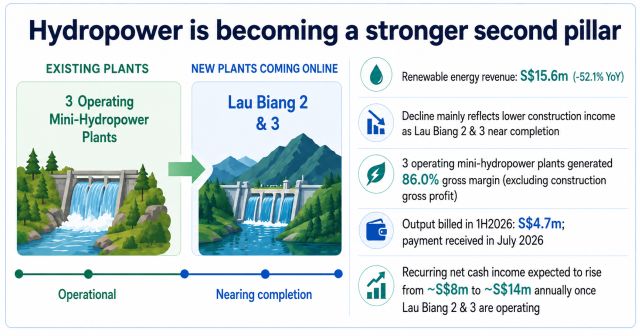
Hydropower is nearing the point where the economics improve dramatically. Renewable-energy revenue fell 52% because construction of Lau Biang 2 and 3 is nearing completion.
Excluding low-margin construction income, the existing operating plants generated an 86% gross margin in 1H26.
Management still expects Lau Biang 2 and 3 to commission in 2026, lifting recurring net cash income from roughly S$8 million to S$14 million annually.
Thus FY2027 should be the first year in which investors see something approaching the full gush of hydropower benefit.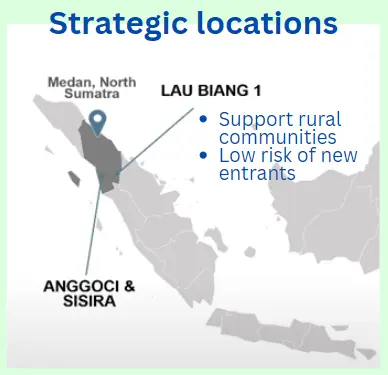 ISDN's 3 operational power plants. Two more (Lau Biang 2 and Lau Biang 3) are being constructed in North Sumatra, with completion this year.
When asked about sustainability, MD Teo Cher Koon said the projects operate under 25-year PPAs (power purchase agreements), after which the contracts can be renegotiated.
He said renewable energy is a high-capex business with strong, recurring income".
Asked whether ISDN might separate its hydropower business, Mr Teo said the company is now exploring the idea more seriously and hopes something could materialise within one to two years.
| Cash gush in July |
As for cash conversion, ISDN produced S$26.8 million of operating cash before working-capital movements, but final operating cash flow was only S$1.0 million.
Some of this is timing-related: ISDN subsequently collected about S$36m from customers by end-July.
As at end-June, the balance sheet had cash of S$66 million against bank borrowings of S$81.3 million.
The most important development isn't the 707% PATMI growth.
While the industrial automation business has moved into a stronger growth mode, two additional mini-hydropower plants will contribute high-margin, long-duration cash generation. |
|||||
 → See also:ISDN: "Harvest" Year Starts Strongly, Fueled by Automation, AI, Semiconductors, Energy


